

There is a moment—silent, invisible, unforeseen—when a breach slips past your defenses.
You don’t hear it.
Your SIEM doesn’t scream.
Your SOC doesn’t flinch.
And yet the adversary enters.
Moves.
Maps.
Steals.
Escapes.
Only after the damage is done do your systems finally light up in a belated chorus of alerts.
This moment is not caused by weak tools. Not by short-staffed SOCs. Not by lack of budget.
It is caused by something far more subtle—and far more dangerous:
The wrong Cybersecurity KPIs.
In 2026, as the global threat landscape expands faster than enterprises can respond, the biggest failures are not happening because of attackers…
…but because organizations are measuring the wrong things, watching the wrong dashboards, and celebrating metrics that don’t prevent breaches.
This guide—written with the urgency and directness today’s CISOs deserve—will show you the truth:
Your KPIs are either your greatest weapon… or your biggest blind spot.
And in 2026, blind spots kill.
The Global Threat Landscape of 2026: Faster. Smarter. Relentless.
The threat landscape has changed. Quietly. Rapidly. Brutally.
Attackers in 2026 leverage automation at speeds human SOC operators cannot match.
Ransomware gangs function like global corporations.
AI-driven reconnaissance makes lateral movement nearly instant.
Zero-day markets are booming.
Supply chain vulnerabilities multiply monthly.
Nation-state actors become more brazen—not less.
But the biggest shift?
Cyberattacks now outpace your dashboards.
They outrun traditional metrics.
They outmaneuver SOC workflows.
They exploit reporting delays.
They weaponize every second that your KPIs fail to illuminate.
This is the new battlefield.
And if you are still using 2020-era KPIs to fight 2026-era adversaries, you are fighting blind.
Why SOCs Fail: The Tyranny of Wrong KPIs
Ask any CISO who has lived through a breach.
Ask any SOC manager who has watched an incident spiral out of control.
The post-incident report almost always reveals the same truth:
The SOC was looking at the wrong numbers.
Wrong KPIs create four deadly outcomes:
1. False Confidence
SOC dashboards look green.
But attackers are already deep inside.
2. Delayed Detection
Critical alerts drown in useless data.
Analysts miss what matters most.
3. Operational Paralysis
Teams chase vanity metrics instead of operational metrics.
Time is wasted. Threats evolve.
4. Catastrophic Breaches
The organization reacts too late.
Costs explode.
Reputation collapses.
It’s not the SOC team that failed.
It’s the system they were forced to follow.
KPIs built out of habit.
KPIs inherited from outdated frameworks.
KPIs chosen because “that’s what everyone else uses.”
But attackers don’t care what everyone else uses.
They care about your blind spots.
The Terror of Blind Spots: What Your Dashboards Aren’t Telling You
Every cyber breach has one common precursor:
Something important was not seen in time.
That “something” may be:
- A lateral movement step.
- An unusual privilege escalation.
- A configuration drift.
- An endpoint that quietly went dark.
- An asset that wasn’t added to monitoring.
- A critical alert buried under hundreds of low-severity logs.
- A vulnerability that exceeded SLA by 171 days.
- A user behavior anomaly flagged… but untriaged.
Blind spots are not theoretical.
They are operational.
They are measurable.
And they are fatal.
The tragedy?
Most SOCs don’t even know where their blind spots are.
Why?
Because they track activity—not visibility.
Volume—not impact.
Noise—not value.
A SOC that cannot see is a SOC that cannot defend.
And that’s where the power of the right cybersecurity KPIs becomes the dividing line between security… and breach.
The Power of Automated Cybersecurity Dashboards: Your Single Source of Truth
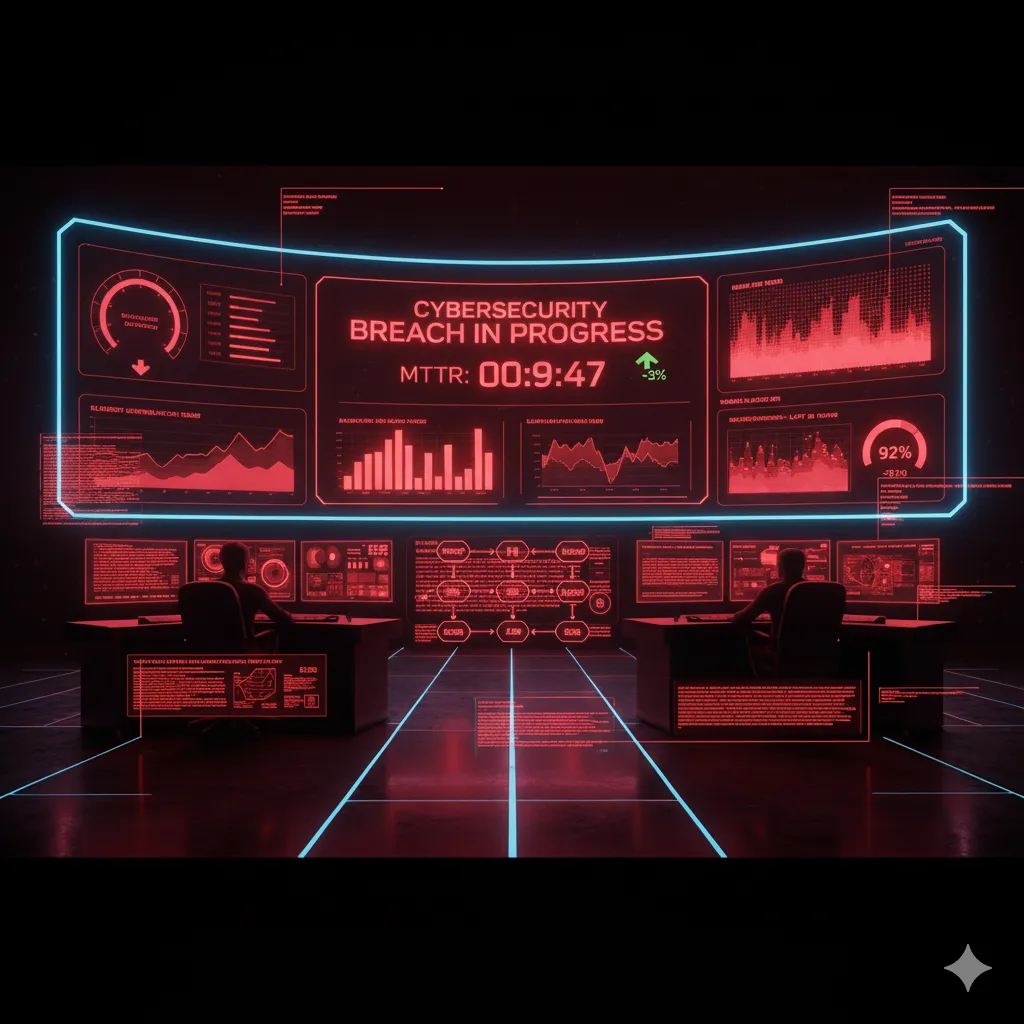
Imagine a SOC where:
- Every KPI updates in real-time.
- Every blind spot is highlighted automatically.
- Every SLA breach is surfaced before escalation.
- Every analyst sees the same source of truth.
- Every CISO can view security posture in one glance.
- Every compliance report is generated instantly.
This is not fantasy.
This is not “future cybersecurity.”
This is the operational standard of 2026.
Automated security dashboards eliminate guesswork and expose risk before attackers exploit it.
They do this in four critical ways:
1. Consolidation of fragmented tools
No more bouncing between ten portals.
2. Reduction of alert noise
Only what matters rises to the top.
3. Real-time KPI calculation
No delays.
No spreadsheets.
No waiting.
4. Predictive analytics
Dashboards reveal where incidents WILL happen before they happen.
In a world where attackers use automation, your defense must be automated too.
The KPIs That Matter in 2026: The Ones That Save You
Here are the cybersecurity KPIs that define whether your organization is prepared—or exposed.
Each one is a pressure point.
Each one reveals hidden risk.
Each one is a weapon in the hands of a skilled SOC.
1. MTTD – Mean Time to Detect
This is the heartbeat of your SOC.
The shorter your MTTD, the fewer opportunities attackers have to spread.
A high MTTD is the oxygen supply of a breach.
A SOC with a 24-hour MTTD is not a SOC.
It is a crime scene waiting to happen.
Your goal in 2026:
Drive MTTD toward minutes—not hours.
2. MTTR – Mean Time to Respond
Respond late, and you might as well not respond at all.
Every minute of MTTR amplifies:
- Ransomware impact
- Lateral movement
- Data exfiltration
- Regulatory fines
- Downtime costs
MTTR is not a metric.
It is a survival timer.
3. Incident Severity Metrics
Severity is your compass.
Without severity breakdowns, you cannot prioritize.
Severity tells you:
- Which incidents demand immediate escalation
- Which require executive attention
- Which drive future investment
- Which reveal systemic weaknesses
Without severity, your SOC is operating in the dark.
4. SLA Breaches & Overdue Tickets
Every SLA breach is a warning.
It is a sign of:
- Understaffing
- Overload
- Bottlenecks
- Noise
- Broken workflows
SLA breaches show the cracks in the system before those cracks break your organization.
5. Endpoint Visibility Coverage
You cannot defend what you cannot see.
Every endpoint offboarded from monitoring is an open invitation to attackers.
Missing endpoints = Invisible battlefields.
6. Alert Fatigue Metrics
Analysts overwhelmed?
Alerts ignored?
Signals missed?
This KPI reveals the silent killer inside every SOC:
Burnout.
A SOC drowning in noise is a SOC inching toward collapse.
7. Patch & Vulnerability SLAs
The longer vulnerabilities sit unpatched, the greater the risk.
Attackers monitor patch cycles.
They wait for gaps.
They strike in the delays.
A global KPI system makes these gaps unforgivingly visible.
8. Detection Rule Effectiveness
How many alerts actually matter?
How many rules fire false positives?
How many rules haven’t been triggered in a year?
Rule drift = Undetected threats.
Rule misalignment = Silent breaches.
This KPI separates the “busy SOC” from the “effective SOC.”
A Global KPI System: Your Shield Against Catastrophic Breaches
Most organizations measure internally.
But attackers exploit externally.
That’s why the most mature cybersecurity programs in 2026 adopt global KPI frameworks—systems that:
- Compare performance across all business units
- Standardize detection SLAs
- Normalize severity scoring
- Equalize response workflows
- Benchmark SOC maturity globally
- Identify regional blind spots
- Provide unified executive reporting
A global KPI framework transforms cybersecurity from a reactive department into a synchronized defense ecosystem.
Without it, enterprises fall into the oldest trap:
Security unevenness.
Some regions are strong.
Some are weak.
Attackers sprint toward the weak ones.
A global KPI system stops this.
Every SOC becomes equally strong.
Every blind spot becomes visible.
Every decision becomes data-driven.
This is how catastrophic breaches are prevented—not with bigger firewalls, not with more tools, but with unified intelligence.
The Real Reason Attackers Win: Slow, Fragmented, Outdated KPIs
Cyberattacks succeed for one simple reason:
Attackers move faster than you measure.
Your KPIs are weekly.
Their attacks are real-time.
Your dashboards are manual.
Their automation is instant.
Your SOC is overwhelmed.
Their bots are tireless.
Attackers don’t win because they’re smarter.
They win because they target the spaces your KPIs don’t illuminate.
Fix the KPIs, and you fix the exposure.
Fix the dashboards, and you fix the detection.
Fix the visibility, and you fix the breach.
The Cybersecurity KPI Checklist for 2026 (Print & Pin on Every SOC Wall)
If your SOC cannot answer “YES” to all 15 items, you have exposure:
- MTTD under one hour
- MTTR under two hours
- Real-time KPI dashboards
- Automated anomaly detection
- Global severity scoring
- Zero SLA breaches for critical alerts
- Endpoint coverage > 98%
- Full visibility over cloud workloads
- Automated reporting to executives
- Predictive threat modeling
- Unified cross-region KPI framework
- Noise reduction strategy in place
- Active detection rule tuning
- Continuous patch compliance monitoring
- Complete elimination of manual spreadsheets
If you hit 10/15, you’re leading the industry.
If you hit 15/15, you’re unbreachable by anything except a true nation-state.
If you hit below 8…
You are already compromised. You just don’t know it yet.
Final Message: 2026 Belongs to the Fastest, Not the Biggest
Cybersecurity has never been a game of tools.
It has never been a game of budgets.
It has never been a game of headcount.
It is a game of visibility and speed.
And visibility and speed come from one place:
Your KPIs.
In 2026, the organizations that survive will be the ones that adopt KPIs that reveal everything—and hide nothing.
The SOCs that thrive will be the ones that automate, unify, and accelerate their dashboards.
The CISOs who lead will be the ones who understand:
Data is defense.
Dashboards are weapons.
KPIs are shields.
And blind spots are fatal.
Fix your KPIs.
And you fix your future.