

Sit with me for a moment.
Clear your desk.
Silence your alerts.
Let the room settle into that quiet hum that every SOC analyst knows —
that hum of systems awake, of logs streaming, of attackers moving behind the walls.
Now I want you to imagine something.
Not a dashboard.
Not a metric.
Not a report.
I want you to imagine the truth.
Because choosing KPIs is not choosing numbers.
It is choosing the truth.
The truth about how fast your team acts.
The truth about where your defenses crack.
The truth about where slow detection becomes silent disaster.
The truth about how powerful — or powerless — your automation really is.
The truth about whether you are winning the war, or whether the threat actors already own the map.
Cybersecurity KPIs are not math.
They are mirrors.
They reflect your strengths, your weaknesses, your failures, your blind spots, your wasted hours, your operational leaks, your heroics, your bottlenecks, and your risks.
They tell the story your SOC may not want to hear —
but absolutely must.
And if Eugene Schwartz were writing this —
if he were alive today, sitting in a glass SOC above a skyline of glowing servers —
he would lean in close and tell you:
“Most organizations measure what is easy.
But the strongest organizations measure what is true.”
So let’s open that truth.
Let’s expose it, examine it, dissect it, sharpen it until it becomes the weapon it was meant to be.
And that begins with choosing the five KPIs that matter more than anything else in cybersecurity incident response.
Not the vanity numbers.
Not the big counts.
Not the colorful charts.
The real KPIs.
The KPIs that cut through the noise.
The KPIs that will tell you whether you win the next breach — or lose it.
Here they are.
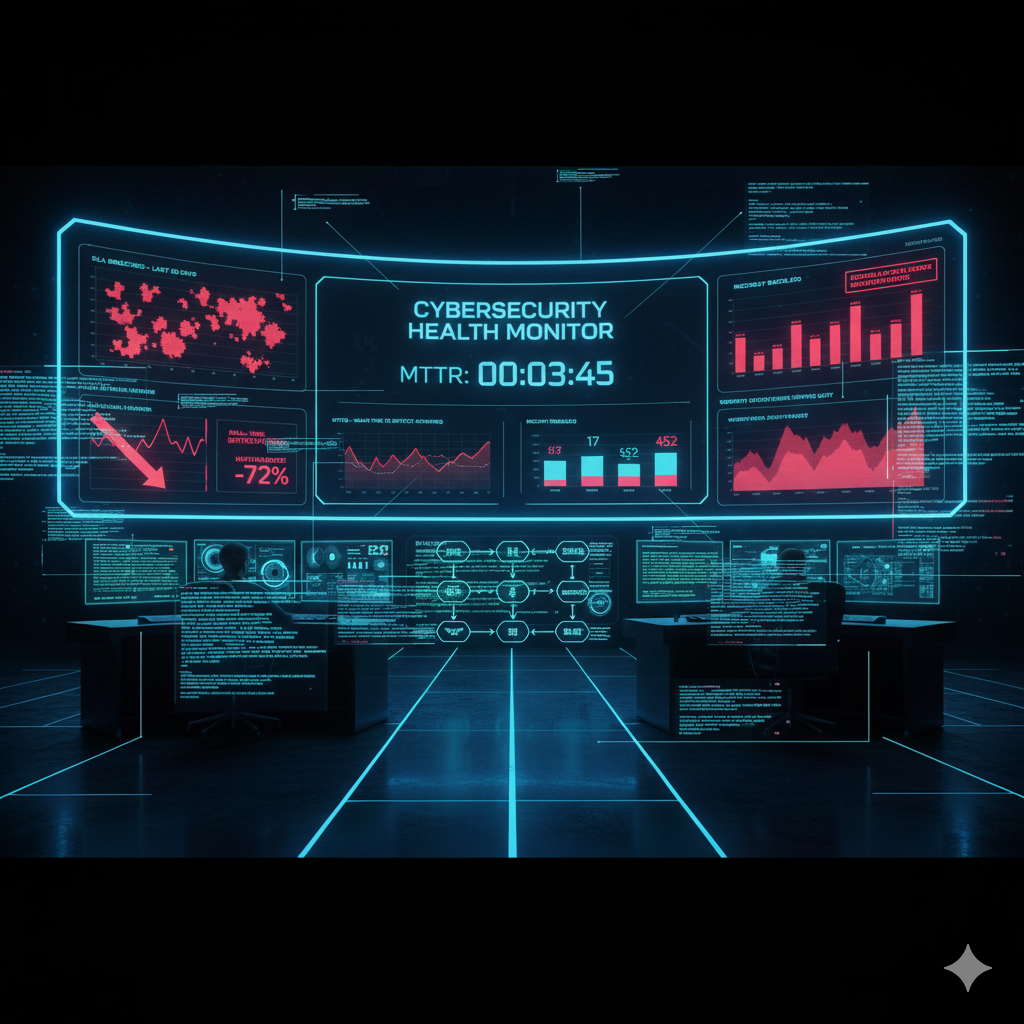
MTTR — Mean Time to Respond
Let us not sugarcoat anything.
If your Mean Time to Respond (MTTR) is high,
you are losing the war.
Not struggling.
Not “working on optimization.”
Not “evaluating tools.”
Not “waiting for more staff.”
Losing.
MTTR is the clearest, loudest, sharpest signal of SOC health.
Because response time is the difference between:
- A contained alert vs. a catastrophic breach
- A quarantined endpoint vs. a company-wide outage
- A revoked token vs. a stolen database
- A quick containment vs. a public incident report
- A minor event vs. legal consequences
MTTR is the stopwatch hanging around the SOC’s neck.
It ticks every second.
Every second of hesitation is a second gained by the attacker.
Let me paint the battlefield:
An attacker moves laterally?
Your MTTR determines whether they reach domain admin.
A phishing credential is stolen?
Your MTTR decides whether they log in before you block them.
A malicious process spawns?
Your MTTR determines whether it spreads.
Your systems — SIEM, EDR, SOAR, firewalls — all exist for one purpose:
to help you respond faster.
This is why Cloud SOAR, cloud-orchestrated dashboards, and real-time intelligence matter so deeply.
They compress the time between threat and action.
Because if MTTR is high, nothing else matters.
Not your tools.
Not your certifications.
Not your dashboards.
Not your headcount.
You are behind.
And in cybersecurity, being behind is fatal.
MTTD — Mean Time to Detect
If MTTR is the war,
MTTD is destiny.
You cannot respond to what you cannot see.
A long MTTD means the enemy is already inside your house,
standing in your hallway,
whispering into your servers,
draining your data while you sleep.
When detection is slow:
- Malware embeds
- Privilege escalates
- Attackers pivot
- Persistence is installed
- Identities are harvested
- Backdoors multiply
- Logs are erased
This is why the greatest SOCs in the world treat MTTD as sacred.
Because slow detection creates:
- Late alerts
- Hidden breaches
- Missed anomalies
- Silent escalation
- Delayed containment
- Incomplete investigations
- Burnout in analysts
But fast detection —
instant detection —
real-time detection —
is destiny.
It allows you to break the attacker’s rhythm.
It denies them time.
And time is the one currency every attacker relies on.
This is why real-time dashboards, auto-refresh monitoring, data orchestration, threat-intel correlation, and automated enrichment are not luxuries —
they are leverage.
They slash MTTD.
They compress the time between event and awareness.
If MTTR is your reaction,
MTTD is your anticipation.
And those who anticipate survive.
Open vs. Closed Incidents
Let me tell you a brutal truth:
Backlog = breach risk.
A backlog of open incidents is a glowing red alert
that your SOC is drowning.
It tells you:
- Your analysts are overloaded
- Your triage is weak
- Your automation is underused
- Your prioritization is flawed
- Your tool stack is creating noise instead of clarity
- Your SOC is reacting but not controlling
Open incidents stack up like uncollected debris on a battlefield.
The longer they sit, the more dangerous they become.
Attackers love backlogs.
They thrive inside them.
Because inside a backlog:
- Alerts age
- Evidence decays
- Sessions expire
- Traces disappear
- Logs rotate out
- Smoke turns to fire
A rising backlog is not a statistics issue —
It is a structural issue.
It is the SOC telling you:
“We cannot keep up.”
And when the SOC cannot keep up,
the attackers take advantage.
Closed incidents, on the other hand, represent:
- Clarity
- Completion
- Control
- Containment
- System health
- Operational readiness
Every closed incident is proof that the SOC is breathing,
functioning,
and winning.
Measure your backlog weekly.
Watch it like a hawk.
Because nothing reveals operational strain more honestly than open vs closed incidents.
SLA Breach Count
Every SLA breach is a neon sign pointing directly at system failure.
It screams:
- “Your workflow is broken.”
- “Your response pipeline is too slow.”
- “Your team is under-resourced.”
- “Your playbooks are outdated.”
- “Your escalation path is unclear.”
- “Your triage is collapsing.”
SLA breaches do not lie.
They cannot be hidden.
They carry no sugar coating.
They expose exactly where the SOC’s weaknesses live.
When SLAs are consistently breached:
- High-severity alerts take too long
- Escalations stall
- Cases die midway
- Analysts multitask and lose focus
- Automation fails silently
- Tickets age without movement
- Responsiveness deteriorates
And here is the dangerous part:
Every SLA breach is an opportunity for attackers.
Attackers adore slow SOCs.
They feast on them.
Because a slow SOC is predictable, easy to outrun, and easy to penetrate.
Reduce SLA breaches and you instantly improve:
- Response precision
- Team discipline
- Alert coverage
- Escalation quality
- Leadership visibility
Measure SLA breaches monthly.
Treat every breach as a root-cause investigation.
Not as a failure —
but as a spotlight revealing exactly where improvement must happen.
Severity Distribution
Now let’s talk about the KPI that almost nobody reads correctly:
severity distribution.
It seems simple.
It seems obvious.
Yet it is one of the purest signals of SOC health.
When high-severity incidents climb,
you are slipping.
When medium-severity cases spike,
you are losing stability.
When low-severity noise floods the dashboard,
your systems are misconfigured.
Severity reveals:
- Attack patterns
- Misconfigurations
- Operational noise
- Policy weaknesses
- Compliance risks
- Threat actor behavior
- SOC blind spots
If your severity distribution shifts upward,
This is not bad luck.
This is not a coincidence.
It is a message.
A message saying:
“Threat actors have found leverage.”
Or worse:
“Your defenses are aging.”
Severity is a thermometer for the SOC’s immune system.
Temperature rising?
Infection spreading.
Track it weekly.
Analyze it monthly.
Investigate every unexpected spike.
Severity tells the truth even when everything else looks calm.
What These Five KPIs Really Reveal
Now let’s step back.
Look at the full set:
- MTTR
- MTTD
- Open vs. Closed Incidents
- SLA Breaches
- Severity Distribution
Together, these KPIs reveal:
Where you are vulnerable.
Not in theory, but in real measurable failure points.
Where your analysts are stretched.
People break long before dashboards do.
Where automation can save you.
If automation is not slashing MTTR or MTTD, it is not automation — it is decoration.
Where leadership must intervene.
Sometimes the KPI does not need tuning —
the org structure does.
Where threats are evolving faster than your SOC.
High-severity spikes rarely lie.
They signal adversaries testing your perimeter — and succeeding.
When you monitor these KPIs consistently, operations shift from:
Guessing → Knowing
Reacting → Anticipating
Scrambling → Executing
Trying → Winning
You stop putting out fires.
You start preventing them.
The SOC becomes a precision instrument.
Every alert gets sharper.
Every response gets faster.
Every workflow gets cleaner.
Every analyst becomes more confident.
Every automation becomes more impactful.
This is the transformation of KPIs into power.
How to Implement These KPIs Inside a Cloud-Orchestrated Dashboard
Let’s be practical now.
Here is how SOC teams actually use these KPIs in real time.
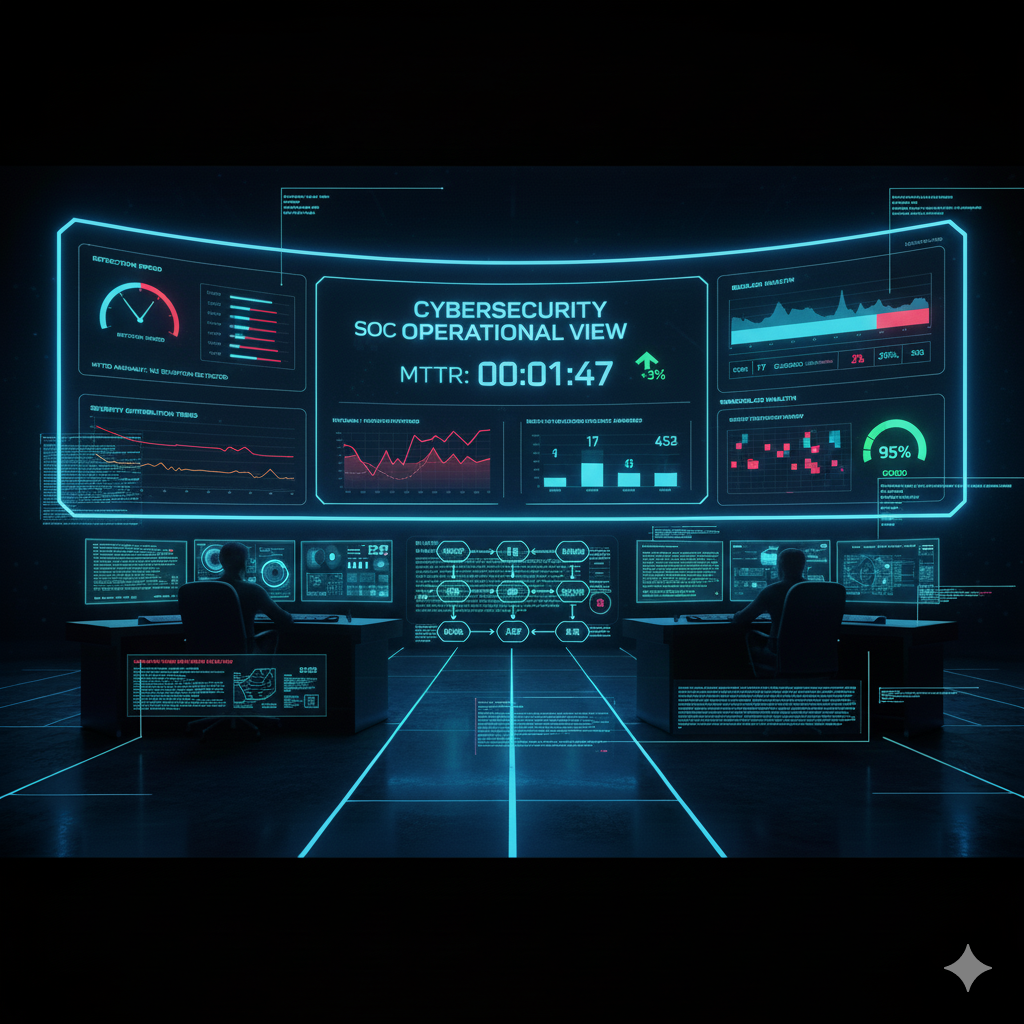
1. Make MTTR the hero metric on your dashboard.
Place it top-center.
Large.
Undeniable.
Visible to leadership at a glance.
2. Track MTTD with automated anomaly alerts.
If detection slows, the system should scream.
3. Show backlog (open vs. closed) as a daily health meter.
If the meter turns red, you take action — today, not next week.
4. Use SLA breach heatmaps.
Let them visually expose weaknesses in tools, teams, or workflows.
5. Trend severity distribution across multiple time ranges.
Look for patterns.
Look for deviations.
Look for evolving threats.
These elements — unified, orchestrated, automated —
create a monitoring system that does not just show data.
It reveals the truth.
And truth is the only foundation strong enough to build a world-class SOC.
The Final Word: KPIs Are Not Metrics — They Are Warnings
If you forget everything else in this long, relentless, truthful article, remember this:
KPIs are not numbers.
KPIs are not charts.
KPIs are not dashboards.
KPIs are warnings.
When MTTR slows — you are being outpaced.
When MTTD rises — you are being outrun.
When the backlog grows — you are being overwhelmed.
When SLAs breach — you are being outmaneuvered.
When severity rises — you are being outmatched.
But when you choose the right KPIs —
and measure them honestly —
your SOC evolves into something unstoppable:
A system that sees clearly.
A team that responds instantly.
A platform that acts intelligently.
A security posture that stands unshakeable.
Without these KPIs, incident response is a guessing game.
With them, it becomes a precision instrument —
sharper than any attacker, faster than any threat,
and ready for any war.
Cybersecurity, Incident Response, SOC KPIs, MTTR, MTTD, Cyber Risk Management, Security Operations, Cyber Threat Detection, CIO Insights, SOC Automation,